EMC Clock Generator PCB
2025-12-08
A two-person course project for TNE089 (Electromagnetic Compatibility and PCB Design) at Linköping University. I designed, fabricated, and measured a small PCB built around the CDCS502, a crystal-oscillator clock generator IC with adjustable spread-spectrum modulation and a x4 frequency multiplier, to see how much spread-spectrum clocking (SSC) and output filtering actually reduce the EMI a clock signal radiates.
A digital clock's harmonics are the whole EMI problem: a square wave's edges pack energy into narrow spectral peaks at the fundamental and its harmonics, and those peaks are what radiate and couple into nearby circuits. SSC attacks this by continuously dithering the clock frequency by a set percentage (0%, 0.5%, 1%, or 2%, selectable via the IC's pull-up-strapped control pins), spreading each harmonic's energy over a wider band instead of concentrating it at one frequency. A low-pass filter on the output attacks it more bluntly, just attenuating the highest harmonics outright. I built the board to drive the IC with either technique enabled independently, along with a linear (not switching, to avoid adding a second EMI source of its own) 5 V regulator, and measured the output on a spectrum analyzer, averaging 100 sweeps per setting to average out the frequency dither and get a stable, comparable trace.
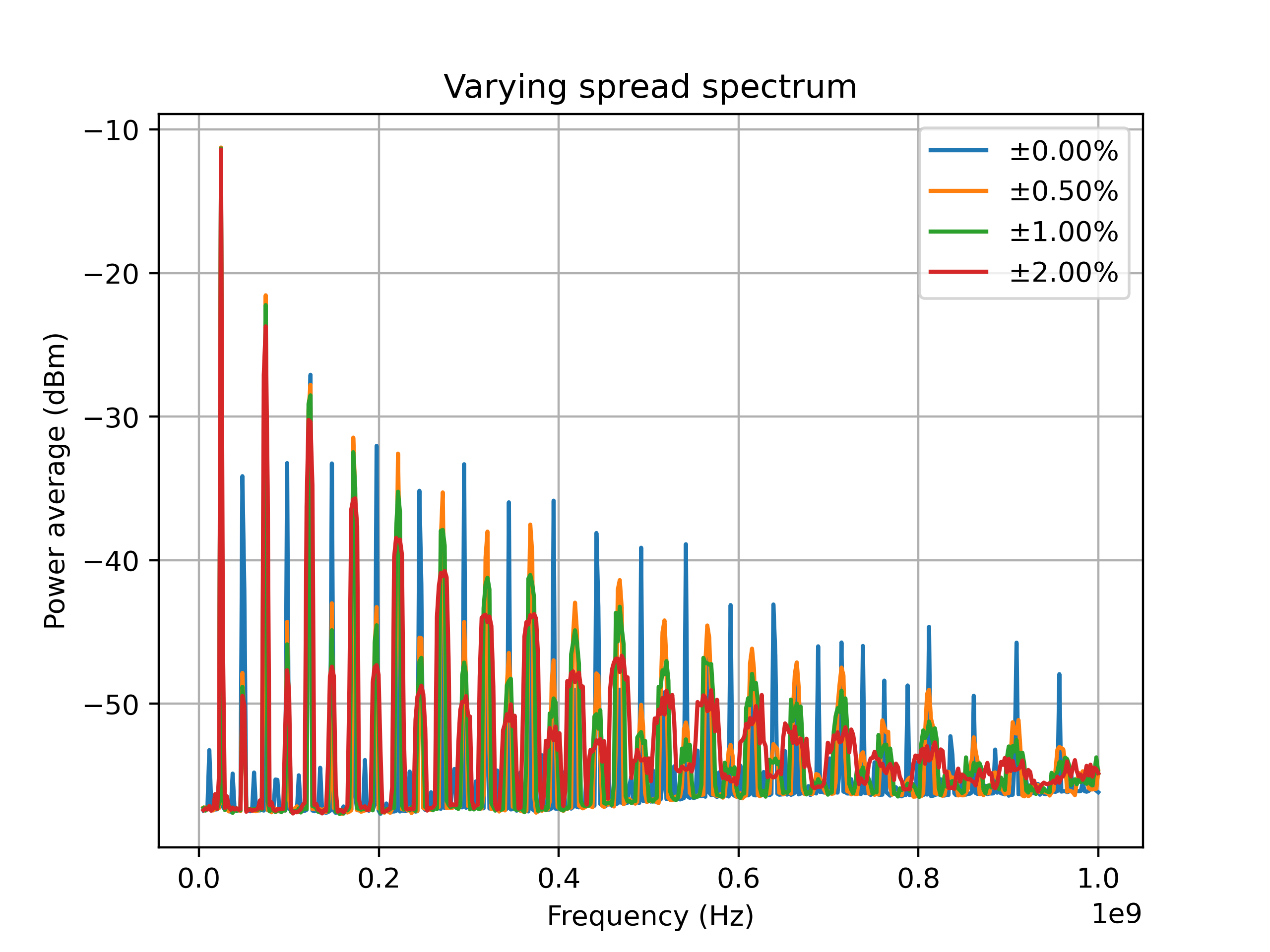
The results matched theory cleanly: turning on SSC visibly flattened the spectral peaks, and the effect scaled with the amount of dither, with even harmonics knocked down by more than 10 dBm going from 0% to 0.5% spread. Odd harmonics proved more stubborn, dropping much less under both SSC and filtering. Filtering was effective at cutting the higher harmonics outright but, being a blunt low-pass, risked distorting the clock waveform itself if the cutoff was set too aggressively. The two techniques are complementary rather than competing: SSC evens out the spectrum near the fundamental while filtering mops up everything further out, and combining them worked better than either alone.